
Most AI creative tools stop at insight. They tag and analyze your ads, tell you what worked, then leave you to produce the next batch by hand. Closing that gap means connecting analysis to generation, so the patterns that drive ROAS turn into new ads across every format, including playables. Segwise runs both halves in one loop: it tags creative down to the element, then generates data-backed image, video, and playable ads from what is actually winning.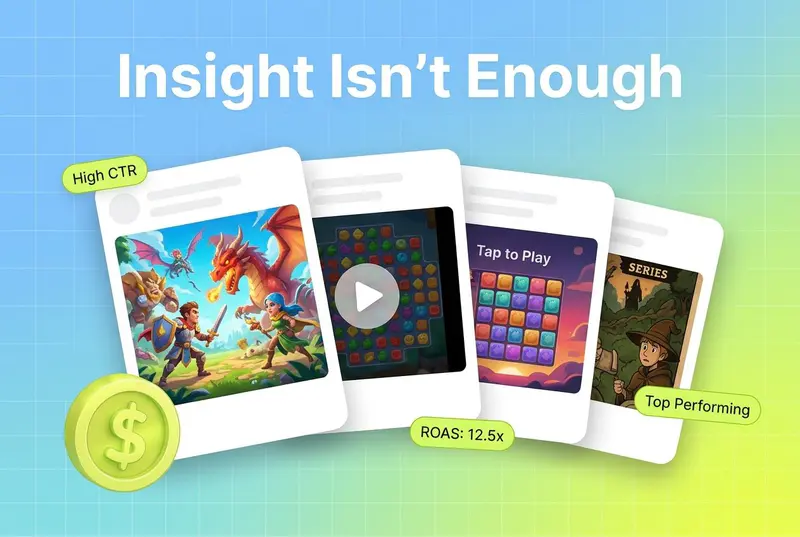
The half of AI creative most teams are missing
Ask a growth team where AI has helped their creative work, and you will usually hear the same answer: it makes analysis faster. AI tags hooks and scenes, flags fatigue early, and summarizes what happened last week. That is real progress. It is also only half the job.
Here is the part that keeps getting skipped. Knowing which hook drove your best ROAS does nothing for next week's spend until someone builds the next ad. And that step, the actual production, is still where most teams jam up. You have the insight sitting in a dashboard, and a designer queue that cannot keep pace with how many variants you need to test.
That gap matters more than it used to, because creative is now the biggest lever you have. A Nielsen analysis found that creative quality drives roughly half of a campaign's sales contribution, more than targeting, reach, or recency. A separate Meta and Nielsen study of 41 brands found campaigns with high-quality creative were about 35% more effective. When creative is the main input to performance, a slow creative pipeline is a slow growth engine.
The volume side makes it worse. In top-grossing mobile games, teams routinely test 50 to 200 raw creative variants per week per title, and a single breakout title has pushed past 3,000 creatives per day at peak. No design team hits those numbers by hand. So the real question is not "can AI tell me what worked." It is "can AI turn what worked into the next hundred ads I need." Most tools answer the first and go quiet on the second.
Key takeaways
Creative quality drives close to half of a campaign's sales impact, more than targeting or reach, according to Nielsen. A slow creative pipeline caps your growth.
Most AI creative tools only inform. They tag and analyze ads but stop before generation, leaving production as a manual bottleneck.
Winning UA teams treat creative like a search problem: generate many genuinely different, data-backed concepts, test fast, and kill losers early.
Playable ads convert at 8x to 16x the install rate of non-playable formats, per Liftoff, yet almost no platform can tag or generate them.
Segwise closes the loop: its Creative Tagging Agent reads what works, and its Creative Generation Agent produces new image, video, and playable ads from those patterns.
Why "inform, not make" became the default
For a while, the smart advice was that AI's job in creative is to inform, not to make. The logic held up: early generative tools produced generic, off-brand output, so pointing AI at analysis instead felt safer. Tag the winners, hand your designers a cheat sheet, keep humans on the actual production.
You can see this thinking baked into how the tool market is organized. Analytics and tagging platforms, including Singular's Creative IQ, sit in the reporting and measurement layer. Generation gets handed off to a separate set of tools like Creatify, Runway, or Canva. The two halves live in different products, run by different people, connected by a human copying insights from one screen into a brief for another.
That handoff is the leak. Every time an insight has to be re-explained to a generation tool that has no idea how your ads actually performed, you lose fidelity and time. The generation tool does not know your tag-to-metric mapping. It does not know that your best-performing hook style is a specific kind of first-second reveal. It just makes something that looks like an ad.
The better generative models changed the calculus. The constraint is no longer "AI cannot make usable creative." It is "AI makes creative that ignores your performance data." Solve that, and inform-versus-make stops being a real choice. The point was never to keep generation away from AI. It was to keep generation grounded in what works.
Creative is a search problem, not a guessing game
The teams getting the most out of AI creative have quietly reframed the whole thing. They stopped trying to predict winners and started building systems to find them faster.
The old model was opinion-led. A creative director picks three concepts, the team spends two weeks producing them, they go live, and maybe one sort of works. The new model treats creative like search: generate a high volume of genuinely different directions, each grounded in performance and competitive data, test them systematically, and double down on the signals that emerge.
That reframe is backed by hard math. In mobile gaming UA, most creative ideas fail, and no prediction engine reliably tells you which ones in advance. That is exactly why the top studios test at the volumes they do and refresh a large share of their creative mix every month. The advantage does not come from guessing better. It comes from moving through the failures faster, at lower cost per attempt. When you can produce and test ten times the concepts in the same window, being wrong on any single ad barely stings.
There is an important nuance here that gets lost in the rush to generate. Volume alone is a trap. Ten variations of the same ad is not a search, it is a reskin. What actually moves performance is diversity: genuinely different bets across emotion, context, and audience. One useful framework from Shamanth Rao of RocketShip HQ maps creative to Emotion, Context, and Audience, then builds each ad by selecting one of each rather than brainstorming from scratch. Rao has reported that this shift cut a client's cost per acquisition by around 70%, because the team was filling gaps in a matrix instead of guessing what to test next. AI is the engine that makes exploring that matrix cheap.
This is the second time the core idea shows up, so it is worth saying plainly: the win is not using AI to make more ads, it is using AI to make more different ads, each one informed by what your data already proved.
The format that breaks almost every tool: playables
If you want to see the inform-and-generate gap at its widest, look at playable ads.
Playables are the highest-converting format in mobile advertising, and it is not close. Liftoff's 2025 Mobile Ad Creative Index, built on 4.7 trillion impressions, found that playables convert at 8x the impression-to-install rate of non-playable formats for top game advertisers, and 16x for others. Other analyses put playable conversion up to 32% higher than video, with users acquired through playables showing meaningfully higher Day 7 retention. Interactive ad spend share keeps climbing year over year.
Now here is the problem. Playables are interactive HTML, not a flat video or image. Most creative analytics tools cannot read them, so they simply drop out of your tagging and your reporting. You are flying blind on your best format. And on the generation side, the tools that pump out static and video ads almost never touch playables, because building an interactive experience is a different technical problem entirely.
So the format with the strongest performance is the one where the inform-and-generate gap hurts most. You cannot learn from what you cannot tag, and you cannot scale what you cannot generate. Segwise is the only platform that tags playable (interactive) ads, and it also generates them, alongside image and video, which is what makes the playable loop actually closable.
What closing the loop looks like
Closing the gap is not about bolting a generator onto an analytics tool. It is about running analysis and generation on the same data, in one continuous loop, so each side makes the other smarter. That is how Segwise is built, around a set of AI agents that hand off to each other.
The Creative Tagging Agent is the foundation. It uses multimodal AI to tag every element of a creative: visual style, characters, on-screen text, hooks, spoken dialogue, audio tone, pacing, CTAs. It works across video, image, audio, text, and playables, and every tag gets mapped to performance metrics automatically. This is the data layer that makes everything downstream grounded instead of generic.
The Creative Strategy Agent sits on top as an always-on AI Chat. You ask it questions in plain language, "which hook style drove the most installs last month," or "what is different about my top five creatives versus my bottom five," and it answers from full context across your account. It also runs fatigue tracking, so you catch decline early instead of after the budget is gone. This is the inform half, and it is genuinely strong on its own.
The Creative Generation Agent is the half most tools do not have. It takes the winning patterns the Strategy Agent surfaces and produces net-new, data-backed creatives across every format: static image, video, and interactive playable ads, plus scene-by-scene video storyboards. It remixes winning elements from across your top creatives rather than reworking a single source. You can refine outputs by prompting, and export in the aspect ratios each network needs.
Then the loop closes. Every AI-generated creative is automatically tagged and tracked once it goes live, so its real performance feeds straight back into the same intelligence that produced it. Analysis informs generation, generation feeds analysis, and the system compounds. Segwise pulls from 15+ ad networks and MMPs, including Meta, Google, TikTok, Snapchat, YouTube, AppLovin, Unity Ads, Mintegral, and IronSource, alongside AppsFlyer, Adjust, Branch, and Singular, so the data feeding the loop is unified rather than scattered across dashboards.
How to build an inform-and-generate creative system
You do not need to rebuild your stack overnight. A practical sequence, adapted from how high-growth UA teams actually roll this out:
Fix your data foundation first. Unify cost, performance, and creative data across every network and MMP. Grounded generation is impossible if your inputs are fragmented or your naming conventions are inconsistent. Everything downstream depends on this.
Analyze before you generate. Tag your existing high performers down to the element and map each tag to a metric. This tells you what is actually working, which is the input generation needs to be more than a guess.
Build a diversity matrix, not a variation pile. Use an emotion, context, and audience framework to define genuinely different creative bets. Aim for range, not repetition.
Generate data-backed concepts across formats. Turn your winning patterns into new image, video, and playable ads. Do not exclude playables just because they are harder; they are your highest-converting format.
Test fast and kill early. Set clear success thresholds and fatigue criteria up front. Move budget toward emerging winners and cut losers before they eat spend.
Close the loop. Make sure new creatives are tagged and tracked automatically once live, so their performance feeds the next round. The shorter the loop from insight to new ad, the faster you compound.
Keep a human in the seat throughout. AI handles the volume, the tagging, and the first-draft generation. People still own brand judgment and the final call on what ships.
The bottom line
AI has made the analysis half of creative genuinely good. The teams that pull ahead from here will be the ones who connect that analysis to generation, so insight does not die in a dashboard but becomes the next ad, in every format, including the playables most tools cannot touch. Inform and make are not opposing philosophies. They are two halves of one loop, and the loop only pays off when both halves run on the same data.
If your creative insights currently live in one tool and your ad production in another, that handoff is quietly costing you speed and ROAS. Segwise runs the whole loop in one place: multimodal tagging, an always-on creative strategist, and data-backed generation of image, video, and playable ads that feeds right back into the analysis.
Frequently asked questions
What is the difference between AI creative analysis and AI creative generation?
Analysis, sometimes called creative intelligence, uses AI to tag and evaluate existing ads so you know which elements drive performance. Generation uses AI to produce new ads. Most tools do one or the other. A closed-loop platform like Segwise does both on the same data, so the patterns analysis finds directly shape what generation produces.
Why isn't AI creative tagging enough on its own?
Tagging tells you what worked, but it does not build your next ad. If the production step stays manual, your creative pipeline still bottlenecks no matter how good your insights are. The value shows up when tagging feeds generation, so winning patterns become new creatives without a slow human handoff in between. Segwise connects those two steps directly.
Can AI actually generate playable ads, not just static and video?
Yes, though very few tools can. Playables are interactive, which makes both tagging and generating them a harder technical problem than flat formats. Segwise is the only platform that tags playable (interactive) ads, and its Creative Generation Agent produces them alongside image and video, which matters because playables are the highest-converting mobile format.
What does the "creative as a search problem" idea mean for a UA manager?
It means stop trying to predict the one winning ad and instead build a system that finds winners fast. Since most creative ideas fail, your edge comes from generating many genuinely different, data-backed concepts, testing them quickly, and cutting losers early. AI makes each attempt cheap enough that being wrong stops being expensive.
How do I get started building a data-backed creative loop?
Start by unifying your cost, performance, and creative data across networks and MMPs, because grounded generation needs clean inputs. Then tag your existing winners, map tags to metrics, and generate new concepts from those patterns across formats. Segwise handles the unification, tagging, and generation in one platform, with historical data imported on setup.
Does using AI to generate creatives replace my design team?
No. AI takes over the volume work: tagging at scale, first-draft generation across formats, and resizing for each network. Humans still own brand judgment, cultural nuance, and the final decision on what ships. The point is to eradicate the tedious production grind, not the creative direction, so your team spends its time on the parts only people can do.