
A 70% drop in cost per install is real in a few documented campaigns, but it almost never comes from AI creative production alone. The honest version: AI cuts the cost of producing variants by 70-90%, which expands the testing surface enough to find winners; the install cost reduction depends on channel strategy, audience signals, creative quality, and how fast you act on the data. For performance marketers, the takeaway is that AI volume without performance data is expensive noise.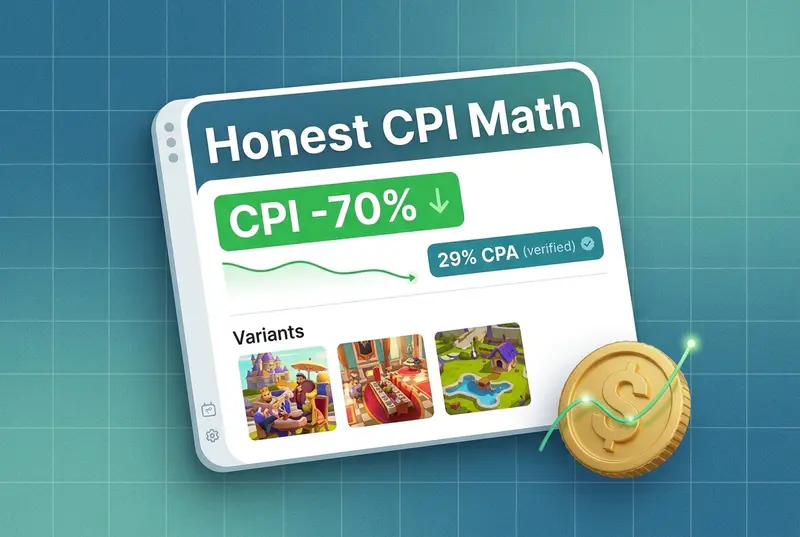
The "AI cuts CPIs by 70%" claim has become the headline of every creative tools vendor pitch. The case studies are real. The Admiral Media PURE App campaign actually delivered a 74% CPI reduction with AI-optimized creative. Other Admiral campaigns documented FET at -66% CPA, Dynamic Creatives at -32% CPA, and StoryBeat at half the production time with double the campaign impact. But read the case studies carefully and a different story emerges: the AI is one input among several, and channel strategy, audience modeling, and creative judgment do most of the heavy lifting in the headline-grade results.
This post walks through the actual cost structure of AI creative, where the production savings are large and well-documented, where the CPI savings break down, and what it takes to defend the 70% claim with data rather than marketing copy.
Also read From Inspiration to Live Ad: The Modern Creative Workflow
Key takeaways
AI cuts ad creative production costs by 70 to 90% versus traditional production methods, according to vendor and agency cost analyses.
AI cuts CPI by 70%+ only when production savings are paired with channel diversification, performance data feedback loops, and creative judgment. The PURE App's -74% CPI came primarily from a Moloco DSP partnership, not AI generation alone.
AppsFlyer's analysis of 1.1 million video creatives shows campaigns running 20+ creative variants delivered up to a 29% CPA reduction, with mixed formats adding another 5%.
PubMatic's AgenticOS launch case showed agentic campaign setup time fell 87% and issue resolution 70%, evidence that AI savings are concentrated in operational layers.
Creative fatigue accelerates with cheap volume. Top mobile game advertisers now ship 2,400 to 2,600 variations per quarter, and saturated auctions push CPIs back up unless winners are identified faster than they fatigue.
The reliable way to defend a 70% CPI claim is closing the loop between AI generation and performance tagging, which is the gap Segwise is built to close.
Why the 70% CPI headline keeps showing up
The 70% number is sticky for a reason. It maps to a few high-profile case studies that vendors and agencies have repeated until they sound like a category-level benchmark. Three real data points feed the meme:
Admiral Media's PURE App case study showed a 74% CPI reduction in the global dating category. The campaign used AI-generated variants tested across markets, and Admiral's companion post on UA agencies cutting CPI attributes the structural move to a Moloco DSP partnership rather than the AI creative alone.
Vendor cost analyses repeatedly show 70 to 90% production cost reductions versus traditional video and design workflows, with Genra.ai's 2026 ROI breakdown citing AI video costs of $0.50 to $30 per minute against traditional ranges of $1,000 to $50,000 per minute.
PubMatic's AgenticOS launch announcement reported an 87% reduction in campaign setup time and a 70% reduction in issue resolution from autonomous agent workflows, which marketers conflate with CPI savings even though those are operational metrics.
Three different things, three different numbers, one number that travels: 70%. When the claim shows up in a sales deck, it is almost always production cost cited as CPI, or a single best-case channel result cited as a category benchmark.
Where AI actually cuts cost
The production cost savings are large and well-documented. Most of the value compounds in four places.
Variant volume
Producing 50 to 100 ad variations in a single workflow session was reserved for the largest in-house teams two years ago. Today, AI production puts it within reach of any UA team with a creative brief. Industry data from gaming UA shows top advertisers now generate 2,400 to 2,600 variations per quarter, up 25 to 30% year over year. The bottleneck is no longer production; it is judgment about what to test.
Production speed
Compression from concept to live ad is the part of the AI value proposition that holds up best under scrutiny. StoryBeat's case study with Admiral Media reported a 50%+ reduction in production time, and that was the single change that doubled their campaign impact. Speed matters because every week saved is another week of performance data feeding the next iteration. Compounded over a quarter, the faster team finishes with a meaningfully larger data advantage.
Voiceover, language, and localization
Voice cloning, multilingual audio, and AI-assisted localization collapse what used to be the most expensive lane of global creative production. A dating app launching in 12 markets used to need 12 separate voiceover sessions and 12 separate creative briefs to adapt copy. AI workflows produce all 12 in a single pass, with quality that runs on Meta and TikTok without the "this looks AI" tax.
Translation and copy variants
Headline testing used to cost a copywriter half a day per variant. With LLMs handling first-draft variants, the cost is closer to zero. The savings here are small in absolute terms but they multiply across thousands of placements.
Add it up and AI production saves between 70 and 90% of the dollars that historically went to creative production, depending on baseline cost and category. That part of the 70% claim is real.
Production cost savings are real, CPI savings are not the same thing. A 70% drop in production cost reduces the cost of testing. It does not, on its own, reduce the cost of an install. The auction still decides what an install costs.
Where AI does not cut cost
The cost structure that AI does not move is the cost of having an idea worth testing in the first place. Two specific failure modes show up across the case studies.
Concept quality
AI is a multiplier on whatever brief feeds into it. A weak brief with strong AI production capacity produces 100 weak variants faster than the old workflow produced 5. The Admiral Media case studies make this explicit: "None of these results were achieved by deploying AI tools without strategic oversight. In every case, Admiral Media's creative strategists developed the testing frameworks, interpreted the performance data, and made the strategic calls about which directions to pursue."
The 70% number assumes someone is doing that strategic layer well. Without it, the same AI workflow produces a flood of variants that the platform algorithm will quietly suppress for redundancy. Meta's Andromeda update made this worse by adding similarity detection that limits distribution of near-duplicates, meaning AI-generated near-duplicates do not even get a chance to run.
Novelty
Production AI is good at producing variants of patterns that already exist. It is much weaker at producing genuinely new creative concepts. The novel hooks, the unexpected framing, the visual language that has not yet been mapped, those still come from human creative thinking. A team running only AI iterations on existing winners eventually exhausts the local optimum and watches CPI climb back up because the audience has seen every viable variation of that concept.
Audience signals and platform optimization
The largest CPI reductions in the documented case studies are not from creative at all. The PURE App's 74% CPI reduction came primarily from a Moloco DSP partnership, not from the AI creative. NeuroNation's 39% CPI reduction came from audience and creative optimization combined. When the headline number sounds too good, the structural move is usually a channel switch.
When the 70% claim is real, when it is marketing
The honest framework: pull apart what is being measured.
A 70% reduction in production cost is real in most well-executed AI workflows. Vendors that publish methodology and per-variant cost breakdowns are accurate. Anyone who has run a multi-market localization through traditional production knows how much money sits in voiceover, translation, and reformat work.
A 70% reduction in CPI from AI alone is not real as a category claim. It is real as a single-campaign outcome when several things align: an underperforming creative baseline that left room to move, a channel switch that gave the campaign access to cheaper inventory, audience modeling that improved alongside creative, and disciplined performance feedback loops. The PURE App campaign hit it. So did some others. They are not representative.
A 29% CPA reduction from running 20+ creatives with mixed formats is the data point that holds up across thousands of campaigns. AppsFlyer's 2025 creative optimization report analyzed 1.1 million video creatives across 1,300 apps representing $2.4 billion in ad spend. Their finding is that volume plus format diversity drives a 29% CPA reduction on average, with mixed formats adding another 5%. That is the realistic floor an AI creative program should be targeting, not the 70% headline.
An 87% reduction in agentic campaign setup time is real in PubMatic's AgenticOS launch case, but it is a workflow metric, not a media efficiency metric. The 70% issue-resolution number in the same announcement is also operational. Both are credible, neither is the same thing as a CPI cut.
What the case studies actually show
Reading the documented case studies side by side, a pattern is clear. The campaigns that hit the highest performance numbers share three properties.
The campaigns that hit the highest CPI reductions all moved structural levers, not just creative ones
The PURE App campaign at -74% CPI moved channel mix to a DSP partnership. The Dynamic Creatives campaign at -32% CPA paired volume with structural campaign restructuring. The FET dating app at -66% CPA paired AI production with creative strategy that systematically tested for subscription conversion, not just installs. In each case, AI was an enabler. Channel strategy, campaign architecture, or downstream creative judgment was the driver.
The campaigns that ran the largest creative volume tended to find winners faster
Star Chef 2 saw +45% ROAS, +55% CTR, and -18% CAC because automated AI workflows generated enough variants to make the testing surface large enough to find winning combinations that traditional production volumes could not reveal. The performance gain came from the testing surface area, not the AI itself. This is the same finding AppsFlyer arrived at with 1.1 million creatives: volume is the variable, not source of variants.
The campaigns with the best results had tight performance feedback loops
In every documented Admiral Media case, the program ran iteratively, with performance data from each market or segment feeding back into the next creative generation cycle. The teams that treated AI as a one-time production cost reduction saw less impact. The teams that treated it as a system, where insights from previous iterations informed the next round, captured most of the upside.
What it takes to actually achieve a 70% CPI cut
The honest implementation playbook looks nothing like "buy an AI tool, get 70% off."
Move multiple levers at the same time
Admiral Media's playbook for cutting CPI and CPA highlights five levers: audience targeting, creative testing, channel diversification, bid strategy, and ASO. The biggest reductions come from moving all five. AI creative production amplifies the second one. It does not replace the other four.
Build the testing surface, then defend it
If the goal is to find winners, the math is unforgiving. Studies of mobile game UA show studios testing 50+ variations per week consistently outperform those testing 5 to 10. Industry win rates run 10 to 15% on average and 20 to 25% for top teams, meaning a team needs to test 50 to 80 variants to reliably find 3 to 5 scale-ready creatives. AI production makes that math feasible at sustainable cost. Without it, finding winners at that rate is prohibitively expensive.
Tag every creative element and map it to performance
The volume increase only pays off if the team can isolate which elements (hook, CTA, character, visual style, voiceover) drive performance. Without that mapping, the next round of AI generation is guessing. With it, each round compounds on the previous. The Segwise Creative Strategy Agent was built for this layer, providing tag-level mapping of every element across all 15+ ad networks and MMPs (Meta, Google, TikTok, Snapchat, YouTube, AppLovin, Unity Ads, Mintegral, IronSource, plus AppsFlyer, Adjust, Branch, Singular).
Detect fatigue before it shows up in CPI
Mobile UA budget size and creative variation count determine the fatigue cycle. An advertiser spending $500,000 monthly with four creative variations reaches ad fatigue twice as fast as one running eight. With AI generating thousands of variants per quarter, fatigue cycles compress further. Without automated fatigue detection, teams catch the decline after the budget is already burned.
Close the loop with data-backed generation
This is the failure mode that turns an AI creative program into a money pit. Teams produce volume, test volume, identify winners, then go back to brainstorming the next round without using the performance data. The teams getting outlier results use winning tag patterns to inform the next generation cycle, not just the next brief.
If you are evaluating an AI creative claim, ask which CPI baseline was used, which channel mix was in place, and what the variant volume looked like. If the answer is fuzzy on any of those, the 70% number is not transferable to your account.
The risk: ad fatigue accelerating with cheap volume
The structural risk of cheap volume is the one that gets the least attention in vendor pitches. When AI makes variants cheap, every competitor scales output at the same rate. The auction fills with creatives. Audiences see more ads from more advertisers, all at once, and fatigue accelerates across the category.
Meta's Andromeda algorithm shift accelerated this by making creative diversity the primary performance lever, with internal guidance now recommending 8 to 15 ads per ad set minimum. The platforms reward variety. They penalize sameness. AI workflows that produce many near-duplicates get suppressed by similarity detection rather than distributed.
The honest framing of the AI creative shift is that it raises the floor and accelerates the cycle. Teams that previously could ship 5 to 10 ads per month can now ship 50 to 100. So can every competitor. The teams that win in this environment are not the ones producing the most. They are the ones identifying winners fastest and rotating them out before fatigue compounds. Performance data, not production volume, is the durable advantage.
This is the practical implication of the 70% headline: production savings are table stakes within 18 months. The new gap is in the speed and quality of the feedback loop between performance data and the next round of generation. Production cost cut to zero with no feedback loop is just spending money to lose money faster.
How Segwise turns the 70% claim into something defensible
The honest version of the 70% CPI claim only holds when AI volume is paired with performance intelligence. That is what Segwise was built for. The Creative Strategy Agent maintains full context across all creative data, tag-level mapping included, and identifies the winning patterns in the existing creative pool. The Creative Generation Agent produces new variants grounded in those winning patterns, in multiple aspect ratios ready for Meta, TikTok, Google, Snapchat, and other platforms. Native fatigue detection monitors performance decline across networks and flags creatives before budget is wasted.
The result is the loop that the case studies above implied but rarely named explicitly. Tag every element. Map tags to performance. Generate the next round from what works. Catch fatigue early. Repeat. Teams running Segwise report up to 20 hours per week saved on manual tagging and consolidation, 50% ROAS improvement, and halved creative production time, with the Creative Generation Agent eliminating the production bottleneck that turns AI promise into AI fatigue.
The bottom line
The 70% CPI claim is real in narrow, structural cases. It is not real as a category benchmark, and it is rarely real from AI generation in isolation. A more honest expectation is a 29% CPA reduction from running 20+ varied creatives, with the upside above that available to teams that combine AI volume with channel diversification, performance feedback loops, fatigue detection, and creative judgment.
The story under the 70% headline is that AI production cost savings are real and large, AI's effect on CPI is downstream of how well it is paired with data, and the durable advantage in this environment is speed of learning, not speed of generation. AI volume without performance data is expensive noise. AI volume with tight feedback loops is the only version of this that scales.
Frequently asked questions
Can AI creative actually cut CPI by 70%?
A 70% CPI reduction is real in a few documented campaigns, most famously Admiral Media's PURE App campaign at -74% CPI, but that result came from combining AI creative with a Moloco DSP partnership, audience modeling, and structured testing. AI generation in isolation typically delivers a 29% CPA reduction from running 20+ varied creatives, according to AppsFlyer's analysis of 1.1 million creatives. Platforms like Segwise, Admiral Media's AI Creative Factory, and similar workflows can push that higher when paired with tight performance data loops, but the 70% number is the upper bound, not the average.
What does the 70% AI cost reduction claim actually mean?
It usually refers to production cost reduction, not CPI reduction. Industry cost analyses put AI video production at $0.50 to $30 per minute versus $1,000 to $50,000 per minute for traditional production, which is where the 70 to 90% number originates. That is a real saving on the cost of making variants. It does not, on its own, reduce the cost of an install. The install cost depends on auction dynamics, audience signals, and creative quality.
How many AI-generated ad variants do I need to test to see CPI savings?
AppsFlyer's 2025 creative optimization report found that automated campaigns running 20 or more creative variants delivered up to a 29% CPA reduction, with mixed formats adding another 5%. Mobile game UA data suggests top teams ship 50 to 100 variants per week to reliably find 3 to 5 scale-ready winners, given typical 10 to 25% win rates. Below 10 variants, the testing surface is too small to find non-obvious winners. Tools like Segwise, AppsFlyer's creative dashboards, and other creative analytics platforms help structure these tests.
What is the difference between AI production savings and AI CPI savings?
Production savings are the reduction in dollars spent making the creative. CPI savings are the reduction in dollars spent acquiring each install. The two are related but not the same. AI production can lower the cost of testing, which lets you find better-performing creative, which can lower CPI. But CPI is set by the auction, not by production cost, and structural moves like channel diversification or audience modeling often drive bigger CPI changes than the AI generation itself. Segwise focuses specifically on closing this gap by linking creative production to performance signals.
Does AI creative make ad fatigue worse?
Yes, in the absence of fatigue detection. When all competitors scale AI production at the same rate, auctions saturate, audiences see more ads, and fatigue cycles compress. Top mobile game advertisers now produce 2,400 to 2,600 variations per quarter. The advertisers who manage this well use tools like Segwise's fatigue tracking, Meta's frequency reporting, and platform-level creative monitoring to catch decline early and rotate variants before CPI rebounds. Without that layer, cheap volume accelerates the burnout cycle.
How do I evaluate vendor claims about AI cutting CPI?
Ask three questions. First, what was the CPI baseline and how was it measured? A 70% cut from a high baseline is easier than from an optimized one. Second, what channel and audience changes happened alongside the AI deployment? If the vendor cannot separate AI's contribution from channel switches or audience model changes, the number is not transferable. Third, how was creative success defined, on installs, subscriptions, ROAS, or all three? Subscription apps like FET at -66% CPA on AI creative are different from install-only optimization. Platforms like Segwise, AppsFlyer, and Adjust make this analysis defensible at the tag level.
What does it take to defend a 70% CPI claim with my own data?
The pattern in the campaigns that actually hit those numbers is the same. Tag every creative element and map it to performance. Move multiple levers, audience, creative, channel, bid strategy. Generate next-round variants from winning patterns, not from brainstorming. Run automated fatigue detection so the loop closes before budget is wasted. Use a unified data layer across all ad networks and MMPs so you can isolate variable impact. The Segwise Creative Strategy Agent was built for exactly this loop, with full integration across Meta, Google, TikTok, Snapchat, YouTube, AppLovin, Unity Ads, Mintegral, IronSource and the four major MMPs (AppsFlyer, Adjust, Branch, Singular).
Is agentic AI advertising actually delivering the operational savings vendors claim?
Yes for narrow operational metrics. PubMatic's AgenticOS launch documented an 87% reduction in campaign setup time and a 70% reduction in issue resolution in early tests with partners including WPP Media, Butler/Till, MiQ, and Olyzon. Those are credible workflow savings. They are not the same thing as a CPI reduction, and marketers should not conflate the two. The operational savings free up time for strategy, which is where the real CPI gains come from. Tools like PubMatic AgenticOS, Segwise, and major DSP optimization layers each address different parts of the agentic stack.