
AI ad creative generation is the practice of using AI to produce new ad creatives, static images, videos, and playable ads, at the volume modern platforms demand. The version that actually works is data-backed: generation grounded in your own winning creative patterns rather than generic prompts. For performance teams, that distinction is the whole game in 2026, because targeting got commoditized and creative is the lever you still control.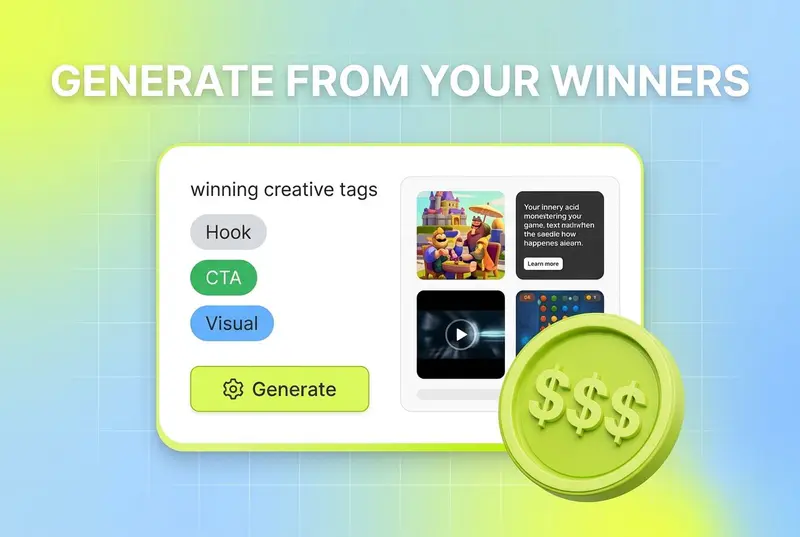
Here is the uncomfortable truth about most AI ad tools right now. They can make you a thousand ads by Friday. They cannot tell you which thousand are worth making. That gap, between volume and direction, is where budgets quietly bleed out, and it is the gap this guide is about.
For most of the last decade, targeting was where campaigns were won or lost. Then the platforms automated it. Meta's Andromeda retrieval engine moved the optimization work inside the algorithm, shifting the advertiser's job from audience targeting to creative diversification, the practice of supplying a wide range of ads with different hooks, themes, and formats. As Jon Loomer's breakdown of Andromeda and several agency analyses describe it, your job changed from controlling the campaign to feeding the system good inputs. When everyone has the same targeting machine, the creative is the only durable edge.
That shift created a problem of scale. Top DTC brands now ship 50 to 70 new ads a week on Meta alone, and the average user sees the same creative 4.2 times before fatigue sets in, with conversion likelihood dropping about 45% by the fourth exposure. No in-house design team produces at that velocity by hand. So generation became mandatory, not optional. The open question is no longer whether to generate ads with AI. It is whether your generation is grounded in anything.
This guide covers what AI ad creative generation is, why generic generation fails, how data-backed generation works as a closed loop with analytics, the formats that matter, and how to build a workflow that turns winning patterns into new winners.
Key takeaways
AI ad creative generation produces new ad creatives at scale across images, video, and playable formats. The useful kind is data-backed: grounded in your winning creative patterns, not generic AI guesses.
Targeting got commoditized. Meta's Andromeda shifted performance from audience targeting to creative diversification, with brands running 15 to 20 diverse active ads and treating creative volume as the main lever.
Adoption is near-universal. 83% of ad executives deployed AI in creative processes in 2025, up from 60% the year before, per IAB data cited by eMarketer.
Generic AI output has a quality cost. Nielsen found human-crafted brand campaigns drove 43% higher unaided recall and 37% higher emotional engagement than AI-generated equivalents, and over 30% of consumers say an obviously AI ad makes them less likely to choose the brand.
Volume without direction is noise. The fix is to ground generation in tag-to-metric data, so each new creative is statistically more likely to work, not just faster to make.
Generation is one half of a loop. Analytics surfaces what wins, generation builds more of it, and each new creative gets tracked back. Segwise closes that loop with its Creative Generation Agent.
What is AI ad creative generation?
AI ad creative generation is the use of generative AI to produce finished ad creatives: static image ads, video ads, interactive playable ads, and the storyboards that plan them. Instead of a designer building each variation by hand, the system produces new creatives, and variations of existing ones, on demand.
That much is now table stakes. 63% of marketers already use generative AI in their marketing, with another 27% evaluating it, according to Jasper's State of AI Marketing 2025. The tools to make ads are everywhere. The harder question is what those ads are based on.
There are really two kinds of AI ad generation, and they are not close in value.
The first is generic generation. You write a prompt, the model makes something plausible, and you ship it. It is fast and it is cheap. It is also a guess. The model has no idea what your audience responded to last month, which hook held attention, or which CTA converted. It optimizes for looking like an ad, not for being one that works for you.
The second is data-backed generation. Here, the system already knows what wins in your account because it has analyzed your performance data at the creative-element level. It generates new creatives built around the specific hooks, visual styles, characters, and CTAs that your own data shows drive results. The output is not a guess dressed up as an ad. It is a hypothesis grounded in evidence.
The difference shows up in the numbers. Generic generation can move volume, but it carries a quality and trust penalty when it stands in for real creative direction.
Why generic AI generation falls short
It is tempting to treat AI generation as a volume problem solved. Need more ads? Generate more ads. But volume without direction is just more noise to sort through, and the research on generic output is sobering.
In Nielsen's testing, human-crafted brand campaigns generated 43% higher unaided recall and 37% higher emotional engagement than their AI-generated equivalents. The reason is intuitive once you see it: generic models optimize for clicks, not for meaning, and they have no point of view about your brand or your audience.
There is a trust cost too. A 2025 study covered by eMarketer found that more than 30% of consumers across every age group say knowing an ad was AI-generated makes them less likely to choose the brand. And the operational risk is real: over 70% of marketers report having hit an AI-related incident in their advertising, from hallucinations to off-brand output, per IAB research.
None of this means AI generation is a bad idea. It means generic AI generation is. The fix is not to generate less. It is to generate from something real.
This is also where eMarketer lands. Its guidance is to use AI for variant generation and testing, and reserve human judgment for brand voice and audience-facing creative where skepticism runs high. The teams getting value out of generation are the ones feeding it good inputs, which brings us to the part most tools skip.
Data-backed generation: the new lever
If targeting is commoditized and volume is cheap, the real lever is direction. Data-backed creative generation is direction at scale.
The mechanism is tag-to-metric mapping. Before you can generate from your winners, you have to know what your winners are made of. That means describing every creative by its elements, hooks, CTAs, characters, visual styles, emotions, on-screen text, audio, format, and connecting each element to performance. Once you have that, you do not generate from a blank prompt. You generate from a brief that says: build more ads around the talking-head problem-first hook and the social-proof CTA, because those are the elements carrying your ROAS.
That is the entire premise of data-backed generation. Every output is grounded in what your performance data shows is actually working, rather than what a model thinks an ad should look like. eMarketer describes the resulting shift bluntly: generative AI lets teams auto-generate variants, run tests, and swap assets daily based on real signals, replacing the weeks-long cycles of traditional creative development.
The strongest version of this is not a one-way street. It is a loop. Analytics surfaces the winning patterns, generation builds new creatives from those patterns, and each new creative gets tracked back into analytics, which sharpens the next round. That feedback loop is what separates generation that compounds from generation that just fills a content calendar.
The closed loop: analytics, generation, tracking
Data-backed generation only works when it is wired to analytics. Think of it as one engine with three stages, not two separate tools.
First, analytics. You unify creative performance data across every ad network and MMP, tag each creative by its elements, and map every tag to the metrics that matter. This is the creative analytics layer that tells you not which campaign won, but which creative elements won. It is the grounding the whole system depends on.
Second, generation. Using that tag-to-metric map, the system generates new creatives built around your winning elements, net-new concepts and variations of proven winners, across formats. Because the brief comes from data, each output is statistically more likely to succeed.
Third, tracking. Every generated creative goes live, gets automatically tagged, and feeds its own performance back into the analytics layer. The loop closes. Next round's generation is grounded in slightly better data than last round's.
That closed loop is the difference between a tool you prompt and a system that learns. Each cycle, the system gets a clearer picture of what your audience responds to, and the generation gets sharper. This is the core idea worth holding onto: in 2026, the edge is not making more ads, it is making more ads that are grounded in what already worked.
The formats that matter: image, video, and playable
Different channels demand different formats, and a generation system is only as useful as the formats it can produce.
Static image ads are the workhorse of paid social and remain the fastest format to test. Variations on a winning image, different headlines, backgrounds, or product framing, let you isolate what is driving a result.
Video is where most attention now lives, and where the first three seconds decide everything. Generating video at the volume Andromeda rewards is hard by hand, which is why video storyboards matter: a scene-by-scene plan of a new video concept that a team or agency can produce against, grounded in the hooks and pacing that performed before.
Playable ads are the interactive format that dominates mobile gaming, and historically the hardest to generate and analyze. Most tools cannot touch them.
The other practical concern is export. Meta, TikTok, Google, and Snapchat each want their own aspect ratios. A generation workflow that does not export in 1:1, 4:5, 9:16, and 16:9 leaves you resizing by hand, which defeats the point.
How Segwise generates data-backed creatives
This is where the closed loop stops being a concept and becomes a product. Segwise is a fully agentic AI-powered creative intelligence and generation platform. You plug in your ad networks, it analyzes everything, and it generates winning creatives based on your winning creative patterns.
The grounding comes from Segwise's analytics layer. It unifies creative data across 15+ ad networks and MMPs, including Meta, Google, TikTok, Snapchat, YouTube, AppLovin, Unity Ads, Mintegral, and IronSource, alongside MMPs AppsFlyer, Adjust, Branch, and Singular. Its Creative Tagging Agent uses multimodal AI to tag every element across video, audio, image, and text, including playable ads, which Segwise is the only platform to tag. Each tag is connected to performance through tag-to-metric mapping. That is the data the generation runs on.
On top of that, the Creative Generation Agent produces net-new and variation creatives, grounded in your tag-to-metric mapping and winning creative patterns rather than generic AI guesses. A few capabilities make it specifically data-backed:
Smart element remixing combines winning elements, hooks, CTAs, visual styles, characters, from across different top creatives into new high-performing ads, rather than reworking a single source.
Winning tag-based iterations identify your top-performing tags, a specific hook style, CTA, or visual emotion, and generate new creatives built around them.
Image, video, and playable generation covers every format, plus video storyboards that lay out scene-by-scene structure for new video concepts to produce in-house or hand to an agency.
Prompt-based creative editing lets you refine messaging, adjust visual elements, or tweak layouts without manual design work.
Multi-format export downloads assets in the aspect ratios each network needs (1:1, 4:5, 9:16, 16:9), ready to upload to Meta, TikTok, Google, and Snapchat.
Then the loop closes. Every AI-generated creative is automatically tagged and tracked once live, so its performance feeds straight back into the same creative intelligence that produced it. Generation and analysis stay connected, which is exactly what generic tools cannot do. The result, per Segwise's stated outcomes, is teams saving up to 20 hours a week per app or brand, improving ROAS by up to 50%, and halving creative production time.
How to build a data-backed generation workflow
If you are generating ads from generic prompts today, here is a sane order of operations to make generation actually grounded.
Unify your creative data first. Pull every creative, from every ad network and MMP, into one place with consistent metric definitions. You cannot generate from patterns you cannot see.
Tag your creatives by element. Describe each ad by its hooks, CTAs, characters, visual styles, audio, and format. Automated tagging makes a rich taxonomy practical, where manual tagging stalls.
Map tags to your real outcome metric. Connect each element to creative-level ROAS or CPI through your MMP, not just clicks. This map is the brief your generation will run on.
Generate from the winners. Use your top-performing tags to brief new creatives, net-new concepts and variations, across the formats each channel needs. Remix winning elements rather than starting from a blank page.
Track everything back. Launch the generated creatives, tag and track them automatically, and feed results into the next round. The workflow is a loop, not a one-time batch.
The teams that scale creative run this loop continuously, not quarterly. The faster it runs, the faster you compound winning patterns into new winners, which is the entire point of generating with AI in the first place.
Common pitfalls to avoid
Generating from blank prompts. If your generation is not grounded in your own performance data, you are buying volume and hoping. Ground it in tag-to-metric mapping.
Chasing volume over direction. More ads do not help if you cannot tell which to make. Andromeda rewards diverse, high-quality creatives, not just more of them.
Treating AI as a replacement for brand judgment. Use AI for variant generation and testing; keep human judgment on brand voice and audience-facing concepts, as eMarketer advises.
Ignoring the loop. Generation that does not feed performance back into analysis cannot improve. Track every generated creative so the next round is smarter.
Skipping formats. If you can only generate static images, you miss video and playable, where attention and mobile budgets increasingly live.
Conclusion
AI ad creative generation is no longer a competitive edge on its own. Everyone can make ads fast now. The edge in 2026 belongs to teams whose generation is grounded in their own winning creative patterns and wired into a loop that tracks every result back. Targeting got commoditized, volume got cheap, and direction became the scarce resource. Data-backed generation is how you supply it at scale.
The practical version of this is simple to state and hard to operate alone: stop generating ads from generic prompts, and start generating from what your data already proved works. That requires unifying fragmented creative data, tagging it at the element level, and connecting generation to analysis so the two never drift apart.
If you want generation that builds from your winners instead of guessing, Segwise unifies your creative data across 15+ networks and MMPs, tags every element automatically, finds your winning patterns, and generates net-new image, video, and playable creatives grounded in that data, then tags and tracks each one once live. It saves teams up to 20 hours a week and helps improve ROAS by up to 50%.
Explore the generation cluster
If you want to go deeper on any part of data-backed generation, these guides break down each piece:
data-backed vs generic AI ad generation explains why grounding generation in your performance data beats prompting from scratch.
generate ad creatives from winning patterns walks through turning your top-performing tags into new winners.
AI video storyboards covers planning scene-by-scene video concepts grounded in hooks and pacing that worked.
generating playable ads with AI gets into the interactive format most tools cannot touch.
best AI ad creative generators compares the tools that ground generation in real performance data.
Frequently asked questions
What is AI ad creative generation?
AI ad creative generation is the use of generative AI to produce finished ad creatives, including static images, video ads, and interactive playable ads, along with the storyboards that plan them. The version that actually performs is data-backed: it generates new creatives grounded in your own winning creative patterns rather than generic prompts. Platforms like Segwise do this by tagging every element in your existing creatives, mapping each tag to performance, and generating new ads built around the elements that drive results.
What is the difference between generic and data-backed creative generation?
Generic generation produces plausible-looking ads from a prompt, with no knowledge of what your audience responded to, so it is essentially a guess. Data-backed generation builds new creatives around the specific hooks, CTAs, and visual styles your performance data shows are winning, so each output is a hypothesis grounded in evidence. The practical difference is hit rate: data-backed generation produces creatives that are statistically more likely to work, while generic output also carries a measurable quality and consumer-trust penalty.
Does AI ad generation actually work, or does it hurt performance?
It depends entirely on what the generation is grounded in. Generic AI output can underperform, with Nielsen finding human-crafted brand campaigns drove 43% higher unaided recall than AI-generated equivalents, and over 30% of consumers saying an obviously AI ad makes them less likely to choose the brand. Data-backed generation avoids most of this by building from your proven winning elements rather than a blank prompt, which is why grounding generation in real performance data matters more than the volume it produces.
How do I generate ad creatives that match what already works for my brand?
Start by tagging your existing creatives at the element level, hooks, CTAs, characters, visual styles, audio, format, and mapping each tag to creative-level performance. Once you know which elements drive your results, you generate new ads built around those winning tags rather than from scratch. Tools like Segwise automate this end to end: they tag your creatives, find your winning patterns, and generate net-new and variation creatives across image, video, and playable formats grounded in that data.
Why has creative generation become so important in 2026?
Because targeting got commoditized. Meta's Andromeda update shifted performance from audience targeting to creative diversification, rewarding advertisers who supply 15 to 20 diverse, high-quality ads rather than those who fine-tune audiences. That pushed creative volume demands to levels no team can hit by hand, with top DTC brands shipping 50 to 70 new ads a week, so AI generation became necessary. The teams winning are the ones whose generation is grounded in performance data, not just fast.
what's the best way to make tons of ad variations without them all looking generic
The trick is to generate from your own winners instead of a blank prompt. If you tag your top creatives and identify the specific elements driving performance, you can remix those winning hooks, CTAs, and visual styles into many new variations that share what works but vary the execution. That gives you volume and diversity without the generic, off-brand feel, because every variation is anchored to something your data already proved resonates with your audience.
How is AI ad generation connected to creative analytics?
They are two halves of one closed loop. Creative analytics surfaces the winning patterns in your existing ads, generation builds new creatives grounded in those patterns, and each new creative gets tracked back in analytics to sharpen the next round. Segwise connects them directly: its Creative Generation Agent builds from your winning tags, and every generated creative is automatically tagged and tracked once live, so generation always stays grounded in real performance data rather than drifting toward generic output.