
An AI ad copy generator turns a product brief into headlines, descriptions or social ad text. For two free search-copy drafts, try AdFlint and zerosoft. In our tote test both wrote a usable laptop headline. Only zerosoft also wrote a zip-led headline. Its first two previews paired both headlines in reverse order, and the third mixed both features in the description. Here is how we edited them into a test.
Segwise is an AI creative analytics and generation platform that tags hooks, benefit statements and calls to action, links them to spend and purchase results reported by connected ad networks, and helps teams draft new hooks from the patterns they find. A useful test starts with a specific question. Would buyers respond better to a tote that fits their laptop or to one that zips closed? Both messages can be true. A paid comparison can show which message brings in purchases at an acceptable cost.
Which AI ad copy generator fits your workflow?
Prices checked 27 November 2026. Segwise starts at $999/month for advertisers spending up to $250K/month; startups spending under $50K/month pay $499/month (limited eligibility). The AdFlint and zerosoft rows lead to the two observed runs below. The other six entries compare documented workflows and plan terms. For one offer and two headlines, a free generator is a reasonable starting point. For a third brand voice or a second writer using Jasper, check the Business quote. For a 60-prediction batch, review the Anyword billing option before committing. Pay for a broader workflow when the recurring problem is approval time, reuse across channels or access to evidence from past ads. If you also need finished images or videos, see the comparison of full ad generation tools.
What did two public ad copy generators actually write?
On 27 November 2026 we ran the brief below once in AdFlint’s Google Search form and once in zerosoft’s Google Ads form, without signing in. In AdFlint we used the advertising field. In zerosoft we named the product and put the same instructions in Key points. Both audience fields said “Commuters”; other controls kept their defaults. We counted spaces and punctuation and checked every factual claim against the brief. These are first-pass outputs, with no paid performance attached.
Write two Google Search headlines for the fictional Navy Commuter Tote, $68. It has a padded sleeve that fits a 14-inch laptop and a zip closure. Lead one headline with laptop fit and the other with zip closure. Maximum 30 characters per headline including spaces. No discount, urgency, waterproofing or theft-prevention claims.
AdFlint delivered the laptop claim but missed the zip angle
AdFlint returned three headlines. “Navy Commuter Tote, $68” used 23 characters, “Fits a 14-Inch Laptop” used 21 and “Padded Sleeve, Daily Commute” used 28. All three fit the 30-character limit, but none mentioned the zip closure. One description ended midway through a CTA with “Shop the Navy”. Another called the tote “structured”, a feature the brief never approved. We kept the laptop-fit fact and discarded both descriptions. Open AdFlint’s generator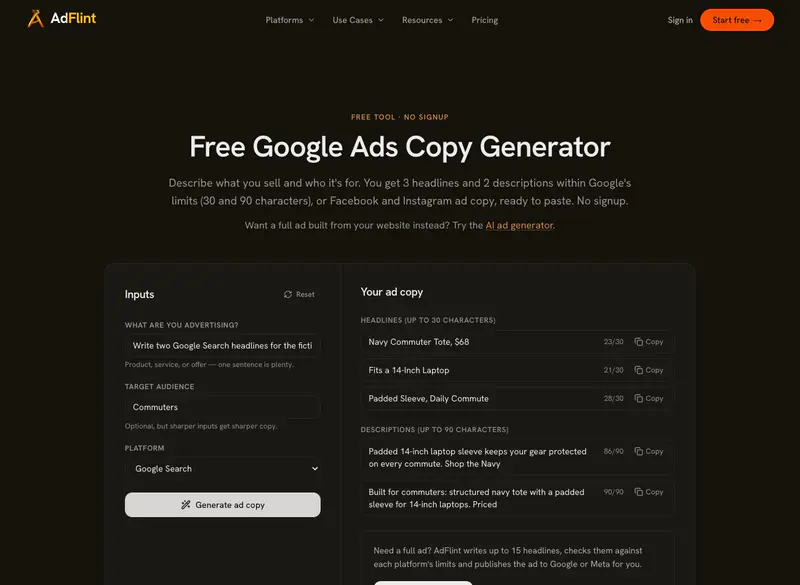
zerosoft supplied both angles, but none of its three variants isolated one
zerosoft returned a 21-character laptop-fit line, a 16-character zip line and the 18-character “Navy Commuter Tote”. The first two headline fields met the brief individually. Read all three rendered previews before approving an A/B pair. Open zerosoft’s generator
| Raw preview from this run | Why it cannot serve as a test arm as shown |
|---|---|
| Fits a 14-Inch Laptop | Zip Closure Tote | The fit-led preview also promises zip closure. |
| Zip Closure Tote | Fits a 14-Inch Laptop | The zip-led preview also promises laptop fit. Its description repeats the sleeve. |
| Navy Commuter Tote | Fits a 14-Inch Laptop | The third preview leads with the product name. Its description says “Padded 14-inch laptop sleeve and zip closure”, so this version also mixes the two buying reasons. |

The buyer’s edit. Extract the useful focal line from each of the first two variants and set aside the third. A valid test requires two clean asset pools. Remove the zip claim from every asset in the laptop arm and the laptop claim from every asset in the zip arm. Give both the same neutral companion headlines, descriptions, image, offer and landing page. If every impression must carry its assigned message, pin just its focal line to Headline 1 in both arms. Otherwise interpret the experiment as adding an eligible asset to the mix. How Google combines and pins search ad assets
When should you use an account-based or team writing tool?
Choose among the following six documented workflows when the public generators solve only the first draft. For a channel handoff, check which ad account or editor receives the copy. For a team purchase, compare the number of people, voices and predictions you actually need.
Segwise for teams with an ad history
Start with a question about the actual ads. “Which benefit statements recur in ads with a low cost per purchase, and which ads are you comparing?” Review those examples, then ask for a new hook or creative brief. This is most useful when a buyer and a designer need to agree on what to make next. A team launching its first search campaign has little account evidence to draw on and can draft its first headlines with a simpler tool. Segwise Creative Strategy
How to check a proposed CTA against the actual offer
Check CTA wording against the offer. In Segwise’s published Pulse fitness example, the proposed ad uses “Get started,” while six of the eight reference winners use “Start your free week.” The useful question for the writer is whether the real offer can be named more clearly. For another brand, confirm its own terms before borrowing that wording. Segwise Pre-flight Testing example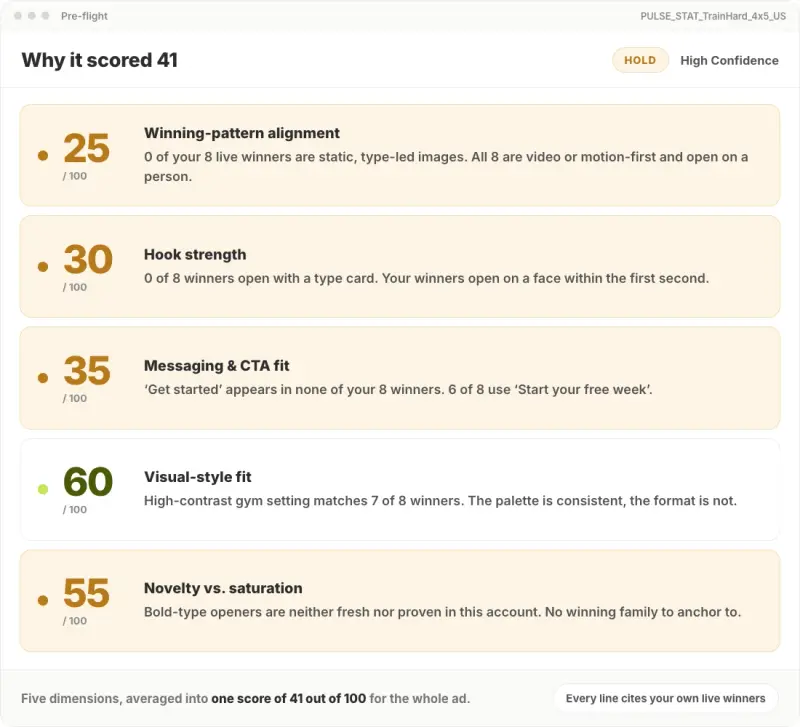
Example data from the Pulse pre-flight scorecard.
Review your next copy test: Segwise lets you inspect the hooks and calls to action in ads that have already run before briefing a new variant. Book a demo.
Ahrefs for free Google ad copy ideas
Ahrefs’ public form asks for the page you want to advertise and offers a language, writing tone and number of variants. Choose it when you want multiple phrasings for the same search intent. Put the intent and approved specifications in the page description, then compare the lines for factual precision. If you need paired Search and Facebook deliverables from one campaign brief, HubSpot provides a separate asset type for each. Ahrefs Google Ads copy generator
HubSpot for a brief shared across channels
Campaign Assistant asks for a campaign topic, key messages and tone. Select the channel before generating. A search headline can echo an explicit query. A Facebook opening needs to make sense to someone who has never searched for the item. For the same tote brief, enter laptop fit and zip closure as separate key messages. Generate Google Search copy first, then select a Facebook ad for a feed opening. HubSpot’s guide lists ten generations per asset. If several stakeholders want more rounds, agree the claim and tone before using that allowance. HubSpot lets you copy the output or continue into its ads tool. HubSpot Campaign Assistant instructions
Google Ads Asset Studio for native asset creation
Open Tools → Asset studio in an eligible Google Ads account. Add an English prompt describing the audience and objective. The multi-asset workflow can also take product images and PDF guidelines. Review short headlines separately from long headlines before adding assets to a campaign. A 90-character long headline from a project is too long for a responsive search ad headline, which allows 30 characters. Google’s prompt workflow · Google Search ad specifications
Jasper for repeatable brand voice
For an agency drafting for several brands, the expensive part can be correcting the same tone errors on every round. Jasper describes using Brand Voice and campaign context to write Google, Meta and LinkedIn ad copy. Give the writer an approved example and a prohibited phrase before asking for variations. Jasper Pro covers one seat and two Brand Voices. A solo writer handling two brands can use those two voices. A third brand or a second user changes the plan discussion. If several writers need their own access, budget for Business and confirm which agents and brand controls are included in the quote. Jasper ad copy workflow · Jasper pricing
Anyword for choosing which draft to test
Anyword scores headline and primary-text drafts before spend. On 27 November 2026 its monthly Starter card showed $49 per month, one seat and 50 performance predictions. The annually billed card showed $39 per month billed yearly and 100 predictions. The comparison grid lower on the same page listed 50 monthly predictions for Starter. For a batch of 15 briefs with four scored drafts each, ask for written confirmation that your chosen billing term covers all 60, what consumes one prediction and when the allowance resets. Do that before committing to the annual plan. A score helps choose a draft to test; paid purchases establish cost. Anyword ad formats · Anyword plan cards and comparison grid
How to write a prompt that produces testable ad copy
1. Give the writer an approved fact sheet. Include the audience, placement, destination, offer, evidence for each claim and language the brand will reject. For the fictional example below, the navy commuter tote costs $68, has a padded sleeve that fits a 14-inch laptop, and has a zip closure. The brief includes no waterproofing, theft-prevention or discount claim. How to write a data-backed creative brief
2. Ask for different reasons to buy. A request for “ten catchy headlines” can yield ten versions of the same idea. Specify the angle and the fields the media buyer needs. Here is a prompt you can paste into a generator and adapt.
Write two Google responsive search ad concepts for commuters buying a navy work tote. The approved facts are a $68 price, a padded sleeve that fits a 14-inch laptop, and a zip closure. Lead concept A with laptop fit and concept B with the zip closure. Give each concept one headline of up to 30 characters. Use the same description of up to 90 characters and the same call to action for both. Return the character count and the approved fact behind each headline. Flag any claim that needs more evidence. Do not add a discount, guarantee or urgency.
3. Prepare two complete search-ad variants. The fit headline below specifies the approved 14-inch size. The zip headline names the other buying reason. Each responsive search ad has the three headlines and two descriptions it needs, including identical neutral companions. In the paid test, keep the focal line in the same headline position on both sides. Google responsive search ad requirements
For paid social, adapt the opening to the feed while keeping the same factual boundary. One primary-text opening could be “Bring your 14-inch laptop along in its own padded sleeve.” The alternative could open “Zip your tote closed before the train pulls in.” Keep the same product photo, offer, destination and button when comparing them. Facebook ad copy best practices
Which claims should a human check before launch?
Read the ad beside the destination page. For each factual promise, the reviewer should be able to point to the supporting line, spec or approved offer. If the generated version says “theft-proof zipper,” replace it with “zip closure.” A zipper is a visible feature. A theft-prevention claim requires separate evidence. If the ad says “20% off today,” the buyer needs to find the same active offer, including its conditions, on the landing page. Google Ads policy on unavailable offers · Google Ads policy on unreliable claims
Check the platform fields yourself. A Google responsive search ad can accept up to 15 headlines and four descriptions, with limits of 30 and 90 characters respectively. Read likely combinations aloud. Two headlines that repeat the same laptop-size claim waste the second field, even if each passes every character check. Google’s responsive search ad guide
How do you know which ad copy performed better?
4. Set one business outcome before launch. For an ecommerce buyer, that might be purchases at or below a target cost. In lead generation, use cost per qualified lead if the sales team can identify qualified leads consistently. Agree on the conversion event, attribution window and decision threshold before either version receives spend.
5. Run a controlled comparison. Keep the offer, image, audience and landing page steady. Google’s ad variations tool lets you test a text change across a selected scope. For example, swap a headline or change a call to action and compare the variation with the original. If the headline must appear on every impression, pin just the test headline in the same eligible position, such as Headline 1, in each arm. With unpinned assets, Google can rotate the line out. That test measures the effect of making a line available to the system. Google’s guide to ad variations
6. Read the result in dollars as well as clicks. Suppose each arm receives 10,000 impressions and spends $240. This is illustrative arithmetic for the tote example.
With an $18 target, the zip arm’s observed $15 per purchase beats the laptop arm’s $20, even though it earned fewer clicks. Twelve versus sixteen purchases does not establish that the result will hold. Use the spend ceiling, end date and conversion window set before launch. If the variation report includes an interval for CPA change, compare it with the smallest saving that would justify a switch. A range from 28% lower to 6% higher CPA includes both a useful saving and a loss. Keep the incumbent. If your report supplies no usable uncertainty estimate, record the arithmetic as directional and leave the budget decision open. Reading a Google ad variation report
Which outcome does an ad-copy benchmark actually measure?
AdTEC evaluates the quality of search-ad text. In 2019, Hughes and colleagues studied generating search ads with reinforcement learning, and CREATER explicitly uses a click-through objective. That distinction matters in the tote example. A model that favors clicks could prefer the laptop message even while the zip message brings in purchases at a lower cost. Choose the evaluation metric that matches the job you are giving the copy. AdTEC benchmark · Hughes et al., KDD 2019 · CREATER research paper
What belongs in the next copy brief?
Save the exact headline, the approved evidence, the placement and the paid outcome together. If the zip-closure message wins on purchases, the next useful question is whether showing the zipper in the image reinforces that promise. Keep the winning line steady for that follow-up. This gives the designer one decision to investigate and the buyer a clear reason to spend on the next version.