
Ad creative fatigue is the gradual decline in performance that happens when your audience sees the same creative too many times, so click-through rate falls, cost per acquisition climbs, and the ad keeps spending while returning less. For performance teams, the real problem is timing: fatigue sets in slowly and most teams catch it only after the budget is already gone. The fix is early detection, watching continuous performance decline and spend-share drop across every creative so you can refresh before the slide turns into wasted spend.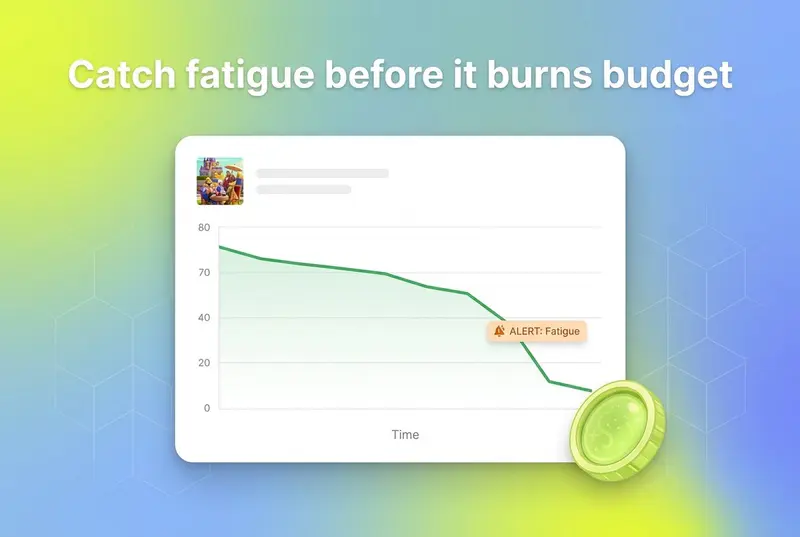
Here is the uncomfortable part about ad fatigue. By the time it shows up clearly in your ROAS, you have usually already paid for it. The numbers do not crash on a Tuesday. They drift down a few percent a day, across dozens of creatives at once, on platforms that each report it differently. So the slide hides in plain sight inside your account averages, and you only notice when a finance review asks why last week cost more for less.
This is the cost of inaction, and it is bigger than most teams assume. One creative fatigue framework estimates that 15 to 25 percent of monthly ad spend is typically wasted on already-fatigued creative. That is not a rounding error. On a six-figure monthly budget, that is the difference between hitting target and missing it, caused entirely by waiting too long to act on a signal that was visible the whole time.
It is also getting worse, not better. Meta's Andromeda ranking system weights creative signals harder than the previous generation, which means a single concept that used to last six weeks now burns through its audience in two or three. Faster decay plus more creatives plus more platforms equals a monitoring problem that no weekly manual scan can keep up with.
This guide covers what creative fatigue actually is, the specific signals that predict it, how fast creatives decay in 2026, how often to refresh, and how to set up early detection so you stop paying the fatigue tax. It sits under our broader guide to creative analytics, which covers measuring creative performance end to end.
Key takeaways
Creative fatigue wastes budget quietly. One framework estimates 15 to 25 percent of monthly ad spend goes to already-fatigued creative, because teams catch the decline after it has cost them, not before.
The earliest signal is CTR decline. A week-over-week drop of 10 to 15 percent deserves attention, and a 25 to 35 percent CTR decline from the launch baseline is a clear fatigue flag.
Frequency is the leading risk factor. On Meta prospecting, performance starts declining above a weekly frequency of 2.5 and falls off a cliff past 4.0.
Creatives decay faster than they used to. Most eCommerce creatives lose efficiency within 7 to 10 days of launch, while B2B and service campaigns get 14 to 21 days.
A sudden spend-share drop is a budget-bleed signal. When a previously strong ad loses more than 20 percent of its budget share inside an automated campaign, fatigue is the likely cause.
No single metric is reliable. The clearest read combines CTR, frequency, CPC, and conversion moving together in the wrong direction over a 7 to 14 day window.
Manual monitoring does not scale. Watching fatigue across hundreds of creatives on multiple platforms is the part teams cannot keep up with, which is why early-warning automation matters more than any single threshold.
What is ad creative fatigue?
Ad creative fatigue is what happens when an audience sees the same creative enough times that it stops responding. The ad does not break. It just fades into the background. People scroll past, click less, and convert less, while the platform keeps serving it and charging you for the impressions. For a focused primer, our deep dive on what is ad creative fatigue breaks down the mechanics in detail.
Marpipe describes it well: fatigue happens when an audience has seen an ad too many times, and instead of clicking or buying, it starts to hum in the background. The mechanics show up consistently across accounts. Click-through rate falls, conversion rate slides, and cost per acquisition creeps up, all while you are spending the same money.
The reason it matters so much in 2026 is that creative is now the main lever you control. Platform automation runs targeting and bidding, so the creative is what decides whether a campaign works. When that creative wears out, you do not have a targeting knob to compensate. You have a fresh-creative problem, and the only real fix is detecting the decline early enough to act.
Why fatigue is a detection problem, not a creative problem
Most teams know their creatives will fatigue eventually. That is expected. The trouble is not that fatigue happens, it is that it happens invisibly and gradually, and account-level reporting hides it.
A creative does not announce its decline. It loses a few percent of CTR per day, sometimes across dozens of creatives at once. Your campaign average smooths all of that out, so the dashboard looks roughly fine right up until the slide is severe. By then the budget waste has already happened. This is why fatigue is best understood as a monitoring and detection challenge. The strategy part, making new creative, is the easy half. Knowing precisely when to deploy it is the hard half.
The early-warning signals that predict fatigue
There is no single formula for creative exhaustion, as Marpipe puts it, but it shows itself clearly across measurements. The teams that catch fatigue early watch a small set of signals together, not in isolation. Here are the ones that matter. If you want the full inventory, we cover the ad fatigue early warning signals in their own guide, and a companion piece walks through how to measure creative fatigue step by step.
CTR decline
Click-through rate is the earliest indicator, and it usually moves first. Triple Whale's framework flags week-over-week CTR drops of 10 to 15 percent or more as something to watch. Once the drop reaches 25 to 35 percent from the launch baseline, fatigue is no longer a maybe. The drop matters more than the absolute number, because every creative starts from a different baseline.
Rising frequency
Frequency is the cause, and CTR decline is the symptom. On Meta prospecting, performance starts declining above a weekly frequency of 2.5 and falls off a cliff past 4.0. Retargeting audiences tolerate more, but the principle holds: the more often the same person sees the ad, the less they respond. Frequency climbing while CTR falls is the classic fatigue pattern.
Climbing CPM and CPA
As response drops, the platform has to work harder to get results, so costs rise. CPM drift of more than 18 percent over a two-week period warrants intervention. On the conversion side, fatigue can be brutal. Marpipe documents a running apparel brand whose CPA doubled from 12 to 22 dollars in just two weeks with no other change to the campaign.
Spend-share drop
This one is easy to miss because it is not a per-impression metric. Inside automated campaigns, the algorithm shifts budget away from creatives it expects to underperform. So when a previously strong ad suddenly loses more than 20 percent of its budget share, that is the system telling you it has lost faith in that creative before your dashboards do. A continuous spend-share drop is one of the cleanest early signals of fatigue.
Read them together, not alone
Any one of these can be noise. Read together, they are a diagnosis. The most reliable signal is several of them moving the wrong way at once over a 7 to 14 day window: frequency up, CTR down, CPC up, conversion flat or falling. That combination is fatigue, and catching that combination early is the whole game.
How fast creatives actually decay in 2026
The window to act is shorter than most playbooks assume, and it keeps shrinking. Knowing your real decay curve is what lets you set detection thresholds that fire in time.
Decay velocity depends heavily on channel and budget. eCommerce creatives generally lose efficiency within 7 to 10 days of launch, while B2B and service campaigns get a longer runway of 14 to 21 days. Channel matters too: Marpipe notes TikTok and Instagram Stories creative can saturate within 7 to 10 days, while LinkedIn stays effective for four to six weeks.
Budget compresses all of it. A creative that stays fresh for 30 days at a 10,000 dollar budget can lose effectiveness within a week at 100,000 dollars, because higher spend means faster frequency accumulation. The more you scale, the more aggressively you have to monitor. And the baseline keeps shifting: with Meta's Andromeda update, concepts that used to last six weeks now burn out in two or three. Any fatigue threshold you set today is probably too slow for next quarter, which is why detection has to be continuous, not a calendar reminder.
How often should you refresh creatives?
There are two schools of thought on refresh cadence, and the right answer uses both. Calendar-based refreshing gives you a baseline rhythm. Performance-based triggers tell you when reality has outrun the calendar. We go deeper on how often to refresh ad creatives in a dedicated guide if you want the full cadence breakdown.
As a calendar baseline, industry benchmarks land around:
Every 7 to 10 days for high-frequency audiences like remarketing and small niche segments
Every 2 to 3 weeks for broad prospecting audiences
Every 4 to 6 weeks for evergreen creative themes
Those ranges come from refresh-cadence guidance across multiple agencies, and they are a starting point, not a rule. The problem with pure calendar refreshing is that it ignores what your creatives are actually doing. A creative can fatigue in five days or coast for three weeks depending on budget, audience, and platform.
That is why performance triggers matter more. Refresh when CTR drops 20 percent or more versus the first week, frequency rises above 4, or CPA climbs 15 to 25 percent without an audience-size change. Use the calendar to plan production capacity, and use the triggers to decide what actually goes live and when.
A useful way to structure the response is in tiers. Triple Whale's framework suggests three: watch when one or two metrics decline 10 to 15 percent, refresh when multiple metrics drop 20 to 30 percent below the 30-day baseline, and replace when CTR is down 40 percent or more and costs have doubled. The earlier you catch the slide, the cheaper the fix.
How to set up early fatigue detection
Knowing the signals is one thing. Watching them across every creative, on every platform, every day, is another. This is exactly where teams fall down, because manual monitoring does not scale past a handful of campaigns. If you are comparing options, our rundown of the best ad fatigue tracking tools covers what to look for before you commit.
Here is a sane setup, in order:
Define your fatigue criteria. Pick the thresholds that match your business. A common one is a 20 percent ROAS decline over 7 days, or CTR down 25 percent from baseline with frequency above your tolerance. Write them down so detection is objective, not a gut call.
Monitor at the creative level, across platforms. Account averages hide fatigue. You need each creative tracked individually, and you need it unified across networks so a creative fatiguing on TikTok is not masked by one still winning on Meta.
Watch spend-share, not just CTR. Continuous performance decline and spend-share drop together are a stronger signal than either alone. Track both per creative.
Get alerted, do not go looking. The point of early detection is that the system tells you before you would have noticed. Alerts that reach you where you work, by email and Slack, turn fatigue from a thing you discover into a thing you are warned about.
Have refreshes ready. Detection only pays off if you can act. Keep a pipeline of new creatives, ideally built from your winning patterns, so a fatigue alert leads to a launch within days, not weeks.
That last point reframes the whole problem. Detecting fatigue early is the same insight as knowing what to make next: both come from understanding which creative elements drive performance and watching them decline. That is where a deliberate AI creative strategy pays off, since the same patterns that flag fatigue should feed your next round of production. And consistent creative tagging is what makes those patterns legible in the first place, so a fatigue alert maps cleanly to the elements that need to change.
Where Segwise fits

This is the gap Segwise's automated fatigue detection is built to close. It monitors all your creatives across platforms for patterns of continuous performance decline and spend-share drop, the two signals that show up before ROAS does. Because the monitoring is continuous and creative-level, fatigue does not get to hide inside an account average.
You set the rules. Custom fatigue criteria let you configure thresholds based on your own business logic, like a 20 percent ROAS decline over 7 days, rather than a generic default that does not fit your accounts. When a creative crosses your threshold, the early warning system alerts you before performance tanks, so you catch fatigue early and avoid the wasted budget that comes from finding out late.
The monitoring runs across every network you connect, not one platform at a time. Segwise unifies creative and performance data from 15+ ad networks and MMPs, including Meta, Google, TikTok, Snapchat, YouTube, AppLovin, Unity Ads, Mintegral, and IronSource, alongside the MMPs AppsFlyer, Adjust, Branch, and Singular. Alerts arrive by email and Slack, so the warning reaches your team in the tools they already use. To be clear about what it does and does not do: Segwise detects fatigue and alerts you, it does not pause ads or move budgets for you. The decision and the action stay with your team.
Detection is only half the loop, though. The same creative intelligence that spots a fatiguing creative also knows which elements made it win in the first place, which is what you need to brief the replacement. And Segwise's creative generation can produce net-new creatives built from those winning patterns, so a fatigue alert can lead straight to a fresh, data-backed variation instead of a blank brief.
The cost of catching it late
The whole danger of creative fatigue is that the slide is slow and quiet, so teams act after the budget is wasted instead of before. Triple Whale's 15 to 25 percent is the headline, but the mechanism is what makes it real: a fatigued ad pairs higher CPC with lower conversion, so the bleed compounds daily. Marpipe's running-apparel example, where CPA doubled from 12 to 22 dollars in two weeks with no other change, shows how fast a fine campaign turns expensive when nobody watches the right signals.
Early detection flips the math. You are not eliminating fatigue, you are shortening the gap between when a creative starts declining and when you act. That gap is where the money goes, and reduced wasted ad spend is the direct payoff.
Conclusion
Creative fatigue is not really a creative problem, it is a timing problem. Every creative fades eventually, and that is fine. What is not fine is paying for the fade because nobody noticed it for two weeks. The teams that win at this are not the ones with fatigue-proof creative, because that does not exist. They are the ones who detect the decline early, while it is still a 10 percent CTR drop and not yet a doubled CPA.
That early detection is the whole point. Watch CTR, frequency, CPM, and spend-share together. Know your real decay curve, which in 2026 is shorter than it used to be. Refresh on triggers, not just the calendar. And above all, monitor continuously, because fatigue hides in averages and moves faster than a weekly review can catch.
If you want fatigue detection that runs in the background instead of on your to-do list, Segwise monitors all your creatives across platforms for continuous performance decline and spend-share drop, lets you set custom fatigue criteria like a 20 percent ROAS decline over 7 days, and alerts you by email and Slack before the budget burns, helping teams reduce wasted ad spend by catching fatigue early.
Frequently asked questions
What is ad creative fatigue?
Ad creative fatigue is the gradual decline in an ad's performance that happens when an audience sees the same creative too many times. Click-through rate falls, conversion rate slides, and cost per acquisition rises, while the platform keeps spending on the ad. It is best understood as a detection problem, because the decline is slow and easy to miss until budget has already been wasted, which is why early-warning monitoring across every creative matters more than any single threshold.
How do I know if my ads are suffering from creative fatigue?
The clearest sign is several metrics moving the wrong way together over a 7 to 14 day window: frequency rising, CTR falling, CPC climbing, and conversion flat or dropping. A week-over-week CTR drop of 10 to 15 percent is an early flag, and a 25 to 35 percent drop from launch baseline is a clear one. A sudden spend-share drop inside an automated campaign is also a strong signal, since the algorithm pulls budget from creatives it expects to underperform.
What frequency causes ad fatigue?
On Meta prospecting audiences, performance generally starts declining above a weekly frequency of 2.5 and falls off sharply past 4.0, according to industry analysis of Meta fatigue patterns. Retargeting audiences tolerate higher frequency before fatiguing. Frequency is the underlying cause of fatigue, so watching it climb while CTR falls is the most reliable early read across most accounts.
How often should I refresh my ad creatives?
A common calendar baseline is every 7 to 10 days for high-frequency audiences like remarketing, every 2 to 3 weeks for broad prospecting, and every 4 to 6 weeks for evergreen themes. But calendar cadence is only a starting point. Performance triggers are more reliable: refresh when CTR drops 20 percent or more versus the first week, frequency rises above 4, or CPA climbs 15 to 25 percent with a stable audience. Higher budgets burn creative faster, so heavy spenders need to refresh more often.
What is the difference between ad fatigue and a bad creative?
A bad creative underperforms from the day it launches, so its metrics are weak from the start. A fatigued creative performed well first and then declined over time as the audience saw it repeatedly. The tell is the trend: fatigue shows up as a downward slope from a strong baseline, usually alongside rising frequency, while a bad creative simply never had a strong baseline to slope down from.
Can ad fatigue detection be automated?
Yes, and at any real scale it has to be. Manually checking CTR, frequency, CPM, and spend-share across hundreds of creatives on multiple platforms every day is not practical, which is exactly why fatigue gets caught late. Automated fatigue detection monitors every creative continuously for performance decline and spend-share drop, then alerts you when a creative crosses thresholds you define. Segwise does this across 15+ ad networks and MMPs, sending early-warning alerts by email and Slack so you act before budget is wasted.
how much budget does ad fatigue actually waste
More than most teams expect, because the loss is gradual. One creative fatigue framework estimates that 15 to 25 percent of monthly ad spend is typically wasted on already-fatigued creative. The waste compounds because a fatigued ad pairs higher CPC with lower conversion, so every day you delay a refresh costs more than the last. Catching fatigue early is the most direct way to recover that spend.